
How Coral Adds Value to the WhatsApp Groups API
WhatsApp built a Groups API; Coral built the tools that make it usable for mid to large companies.
.png)


Integrate your CRM with other tools
Lorem ipsum dolor sit amet, consectetur adipiscing elit lobortis arcu enim urna adipiscing praesent velit viverra sit semper lorem eu cursus vel hendrerit elementum morbi curabitur etiam nibh justo, lorem aliquet donec sed sit mi dignissim at ante massa mattis.
- Neque sodales ut etiam sit amet nisl purus non tellus orci ac auctor
- Adipiscing elit ut aliquam purus sit amet viverra suspendisse potenti
- Mauris commodo quis imperdiet massa tincidunt nunc pulvinar
- Adipiscing elit ut aliquam purus sit amet viverra suspendisse potenti
How to connect your integrations to your CRM platform?
Vitae congue eu consequat ac felis placerat vestibulum lectus mauris ultrices cursus sit amet dictum sit amet justo donec enim diam porttitor lacus luctus accumsan tortor posuere praesent tristique magna sit amet purus gravida quis blandit turpis.

Techbit is the next-gen CRM platform designed for modern sales teams
At risus viverra adipiscing at in tellus integer feugiat nisl pretium fusce id velit ut tortor sagittis orci a scelerisque purus semper eget at lectus urna duis convallis. porta nibh venenatis cras sed felis eget neque laoreet suspendisse interdum consectetur libero id faucibus nisl donec pretium vulputate sapien nec sagittis aliquam nunc lobortis mattis aliquam faucibus purus in.
- Neque sodales ut etiam sit amet nisl purus non tellus orci ac auctor
- Adipiscing elit ut aliquam purus sit amet viverra suspendisse potenti venenatis
- Mauris commodo quis imperdiet massa at in tincidunt nunc pulvinar
- Adipiscing elit ut aliquam purus sit amet viverra suspendisse potenti consectetur
Why using the right CRM can make your team close more sales?
Nisi quis eleifend quam adipiscing vitae aliquet bibendum enim facilisis gravida neque. Velit euismod in pellentesque massa placerat volutpat lacus laoreet non curabitur gravida odio aenean sed adipiscing diam donec adipiscing tristique risus. amet est placerat.
“Nisi quis eleifend quam adipiscing vitae aliquet bibendum enim facilisis gravida neque velit euismod in pellentesque massa placerat.”
What other features would you like to see in our product?
Eget lorem dolor sed viverra ipsum nunc aliquet bibendum felis donec et odio pellentesque diam volutpat commodo sed egestas aliquam sem fringilla ut morbi tincidunt augue interdum velit euismod eu tincidunt tortor aliquam nulla facilisi aenean sed adipiscing diam donec adipiscing ut lectus arcu bibendum at varius vel pharetra nibh venenatis cras sed felis eget.
The WhatsApp Groups API has recently transitioned from beta to full release, marking a significant milestone in WhatsApp’s broader messaging ecosystem. This development builds on earlier advances that combined the Standard Business API with the Voice Calling API, opening up new possibilities for client engagement at scale. See the previous post on the intersection between these 3 Major WhatsApp APIs for more background. If you have business questions about WhatsApp Groups API we also have an FAQ post here.
Against that backdrop, a central question emerges: when should a business or developer build directly on WhatsApp’s raw Groups API, and when is it worth leveraging an additional layer like Coral?
When to Go Directly to WhatsApp
There are clear scenarios where it makes sense to build directly with WhatsApp Groups API. Developers already working inside WhatsApp Business Manager, familiar with the company’s processes and tools, can continue seamlessly within that environment.
If you are a large developer (AKA: WhatsApp BSP or experienced WhatsApp Tech Partner), and you have a partner manager, you should go direct, and feel free to reach out to me with any questions too. The raw Groups API also works well for pure B2C use cases. Imagine eight friends planning a vacation together: all participants are consumers, and the goal is to collaborate on flights, hotels, and activities. For this type of consumer-to-consumer scenario, building directly with WhatsApp’s APIs is the right decision based on the simplicity of your use case.
Where Coral Adds Value
When the use case involves contrasting role dynamics (employees vs clients or buyers vs sellers), the situation changes. Coral has built features and infrastructure that distinguish between these roles, allowing businesses to manage permissions and workflows in a manner that WhatsApp’s raw infrastructure does not.
Consider luxury retail clienteling. A Gucci seller/advisor may invite a client to a WhatsApp chat to promote a red-carpet product launch. The advisor can casually engage the client and extend an invitation, but must also log the RSVP in Gucci’s CRM system. Coral enables this flow to happen seamlessly, with AI agents handling the automation. This ensures that only the employee can command the assistant, maintaining governance and protecting brand integrity. Luxury Retailers also insist on not having annoying bots in the chat with their valuable clients, so the corpus of data that is collected, and the buyer and seller roles within that data set, becomes the core value to the business.
Real estate offers another example. A couple purchasing a new home may be in a WhatsApp Chat with their agent. When a contract must be issued, signed, and stored in the broker’s CRM before forwarding to a title company, Coral ensures the workflow is compliant and controlled by the business. Perhaps the title company is added into the group chat for that portion of the process, and then removed. Permissions rest with the employee, while automation accelerates the process.
Coral equips employees with command menus embedded directly in the WhatsApp app. This makes it easy to trigger structured actions in real time without leaving the conversation. Such commands should only be available to the employee and not other participants, another logic layer that Coral has built that’s not available on the raw WhatsApp Groups API.
.png)
Managerial Visibility and Analytics
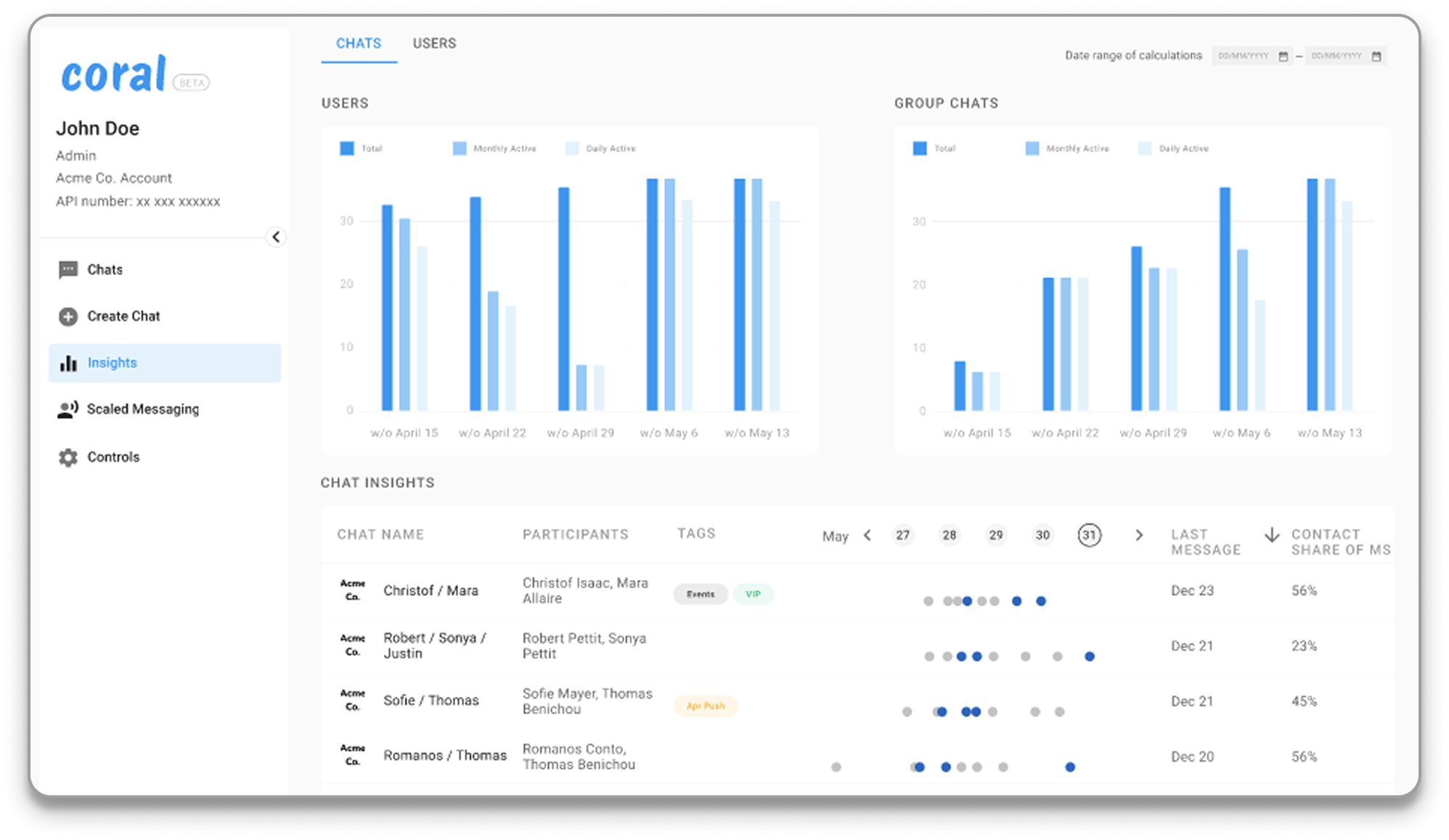
For managers of client-facing teams, Coral transforms WhatsApp from an opaque channel into one of measurable impact. Previously, conversations between employees and clients were hidden on personal devices. With Coral, managers can see which conversations are active or dormant, which are driving sales, upsells, or cross-sells, and how closely employees are following established playbooks.
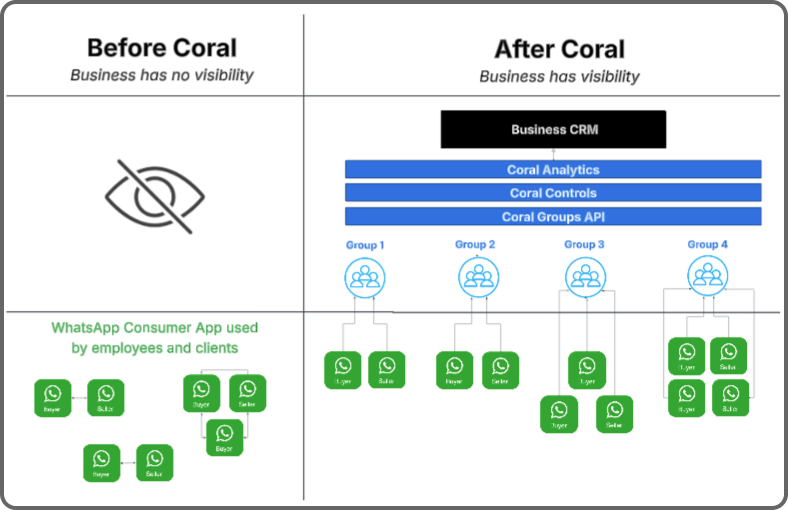
The analytics layer is especially critical in verticals such as financial services, where compliance and oversight are paramount. In luxury retail and services, managers highlight two additional benefits. First, client transferability: when a concierge leaves, top clients can be reassigned seamlessly to another advisor. Second, talent development: younger advisors can be trained against proven conversation patterns and playbooks, improving consistency and performance.
The business implications are significant: once employee WhatsApp conversations are visible, they can be measured and managed, turning employee WhatsApp messages into revenue growth for the business.
Value to the Client
The client also gains from this model. By automating manual tasks, employees can focus on the client experience or closing deals. Employees can command their Coral virtual assistant in the chat to answer frequently asked questions or delegate routine workflows to AI agents, all under their control. Reminders ensure that questions do not go unanswered and playbooks are followed consistently.
The result is a smoother experience: fewer gaps, quicker responses, and greater confidence that their needs will not be overlooked. At the end of the day, clients receive higher-quality service delivered more efficiently.
Conclusion
Could someone develop directly on the raw WhatsApp Groups API and deliver a similar experience? Answer: Yes. But it would likely take a year of investment to replicate what Coral built from 2024 to 2025: infrastructure and a feature set that distinguishes between employees and clients, command menus, AI agents, and workflows that operate seamlessly within the WhatsApp consumer app.
If developing from zero is the path you want to take, the tools are there.
If not, we are dedicated to driving business value from this new API. Coral was founded to make blind sales conversations visible to businesses and to turn this new found visibility into growing your business.
.png)
.png)
